
Our journey from traditional training to transformative learning
Revolutionizing learning in clinical research
Remember when clinical research training meant sitting in a classroom for days, flipping through massive binders of SOPs? Those days feel increasingly distant as our industry races forward. At Parexel Academy, we’ve been on our own journey of transformation, reimagining how we develop talent in an industry that never stands still.
The stakes are high. As clinical trials become more complex and technology-driven, the knowledge and skills our teams need evolve constantly. This isn’t just about keeping pace; it’s about anticipating what’s next and ensuring our learning approaches are as innovative as the science we support.
In this post, we’ll share some insights from our ongoing quest to create learning experiences that truly stick—approaches that go beyond traditional training to create meaningful, lasting impact for our professionals and, ultimately, for the patients we serve.
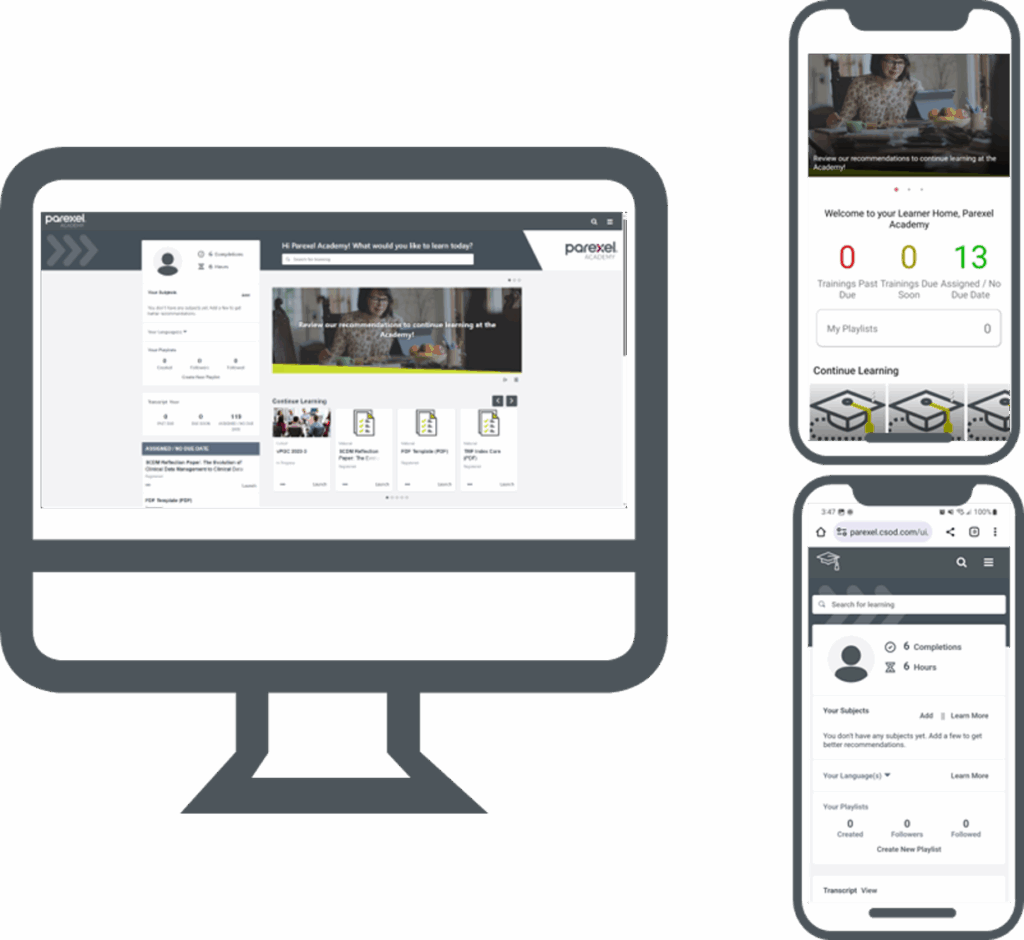
The evolution of learning in clinical research
Let’s be honest, clinical research has changed dramatically in ways we couldn’t have imagined even a decade ago. We’ve moved from paper case report forms to sophisticated EDC systems, from local studies to global trials spanning continents, and from traditional statistical approaches to AI-powered data analytics.
From traditional to transformative
Our learning approaches needed to evolve just as dramatically. Those classroom lectures and three-ring binders served us well for years, but today’s clinical research environment demands something different. When a CRA needs to understand a protocol deviation while on-site, or a project manager needs to make a quick decision about an enrollment challenge, they can’t flip through a training manual from last year’s workshop.
What we’ve discovered at Parexel Academy is that truly effective learning needs to be:
- Available exactly when someone needs it (not just during scheduled training blocks)
- Tailored to individual experience levels (not one-size-fits-all)
- Engaging enough to compete with countless other priorities
- Connected to measurable outcomes (not just completion certificates)
- Directly applicable to the challenges our teams face every day
Our innovation toolkit
Microlearning: Knowledge in digestible bites
We’ve all been there trying to stay focused during hour eight of a training marathon, wondering if we’ll remember any of this tomorrow. That’s why we’ve embraced microlearning—focused, bite-sized modules that deliver exactly what you need without the fluff.
Instead of a four-hour GCP refresher, imagine a 15-minute module on informed consent updates right before you conduct a site initiation visit. Or a quick interactive scenario on handling protocol deviations just when you’ve encountered one. Our teams are telling us this approach isn’t just more convenient, it’s actually helping them retain and apply information when it matters most.
The days of day-long training sessions are giving way to focused, bite-sized learning modules. Our microlearning approach delivers concentrated knowledge in 15-minute segments, allowing professionals to:
- Learn during brief windows of availability
- Focus on specific competencies
- Refresh critical knowledge just before it’s needed
- Build knowledge progressively without overwhelming cognitive load
Immersive technologies: Learning by doing
Think of a first monitoring visit. Can you imagine that mix of excitement and terror? What if professionals could practice it multiple times in a risk-free environment first?
That’s the power of our immersive scenario-based training:
With realistic clinical scenarios, CRAs can practice site visits before ever stepping foot in a clinic. They navigate challenging conversations with site staff, identify documentation issues, and build confidence without the pressure of a real visit.
Interactive simulation training is changing the game for technical skills. Imagine working through a complex medical device procedure with step-by-step guidance or reviewing a laboratory setup with interactive elements highlighting critical quality control points. These scenario-based simulations allow our teams to make mistakes safely and learn from them before they matter in the real world.
The science behind our innovations
Let’s share some of the research that guides our approach:
We carefully design with cognitive load in mind—the brain can only process so much new information at once. That’s why we break complex topics into manageable chunks and build in practice time before adding new concepts. The “forgetting curve” is real—we typically lose about 70% of new information within 24 hours if we don’t reinforce it. Our spaced repetition approach reintroduces key concepts at strategic intervals to combat this natural forgetting.
The “forgetting curve” is real—we typically lose about 70% of new information within 24 hours if we don’t reinforce it.

Testing yourself on material is one of the most powerful learning techniques. much more effective than re-reading or highlighting. That’s why we build in frequent, low-stakes knowledge checks throughout our learning experiences.
And we never underestimate the power of learning from peers. Our collaborative platforms allow professionals to share their real-world experiences and learn from colleagues who’ve faced similar challenges.
Conclusion: Human-centered innovation
With all this talk of technology, we want to emphasize something important: our innovation strategy is fundamentally human centered. The best technology in the world doesn’t matter if it doesn’t connect with how people actually learn, work, and grow.
Every innovation we pursue starts with a simple question: How will this help our professionals deliver better outcomes for patients? Technology is just a tool—our people are the true innovation drivers.
The journey from chalkboards to chatbots isn’t really about technology, it’s about creating learning experiences that respect our professionals’ expertise, time, and dedication to patients. It’s about building knowledge and skills that translate directly to better clinical research.
At Parexel Academy, we’re committed to this journey of continuous innovation—not because it’s trendy, but because the patients waiting for life-changing treatments deserve nothing less than our very best.